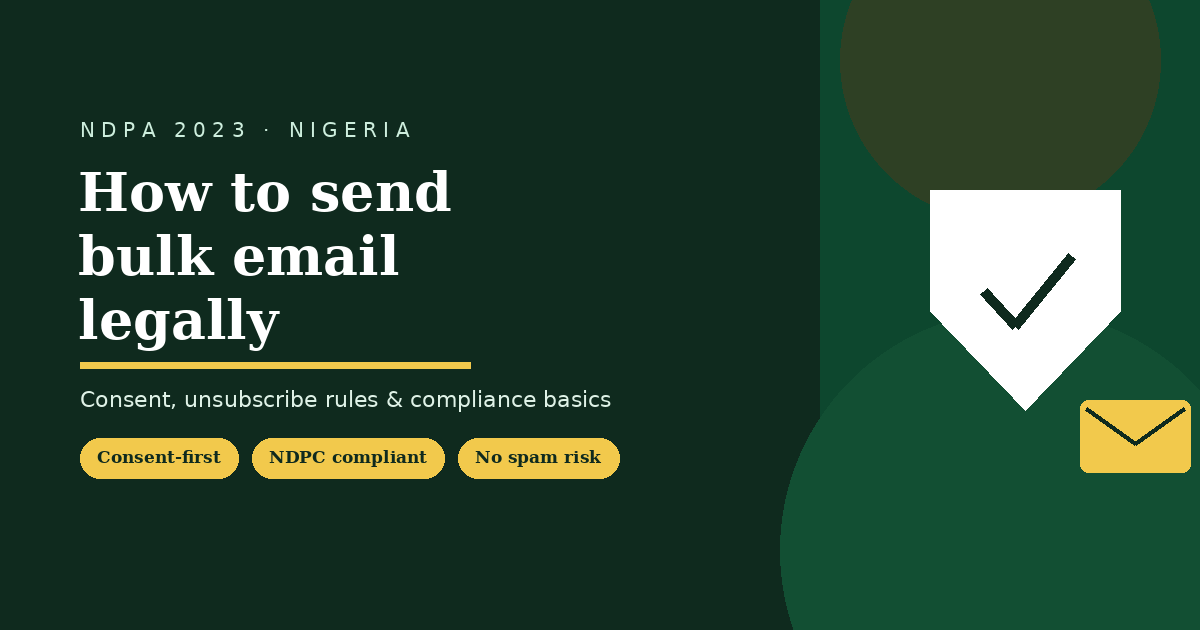
Sending bulk email legally in Nigeria comes down to three things: get valid consent before adding anyone to your list, give every recipient a clear, working way to opt out, and use an email platform (not your personal inbox) built to handle sending at scale without triggering spam filters or abuse complaints. The legal backbone here is the Nigeria Data Protection Act (NDPA) 2023, enforced by the Nigeria Data Protection Commission (NDPC) under the General Application and Implementation Directive (GAID) issued in 2025. Sending unsolicited bulk email to people who never agreed to hear from you — commonly called spamming — also carries exposure under Nigeria’s Cybercrimes Act. This guide walks through what “legal” actually requires, step by step.
The Legal Framework You’re Working Under
Two pieces of legislation matter most for anyone sending bulk email from or into Nigeria:
The Nigeria Data Protection Act (NDPA) 2023. Signed into law in June 2023, the NDPA replaced the older NDPR framework and established the NDPC as the regulator responsible for enforcement. As of September 2025, the General Application and Implementation Directive (GAID) is the authoritative rulebook for how the NDPA is applied in practice. The NDPA governs how you collect, store, and use anyone’s personal data — and an email address tied to a name is personal data.
The Cybercrimes (Prohibition, Prevention, etc.) Act. Nigeria’s cybercrime legislation treats unsolicited electronic messaging as a serious matter, with the broader framework carrying substantial fines and potential imprisonment for offenses involving unauthorized use of electronic communications. The core principle that shows up across Nigerian cyber law repeatedly: sending electronic messages to people you have no relationship with, without their agreement, is where legal exposure begins.
Together, these mean bulk email in Nigeria isn’t just an email marketing best-practice question — it’s a compliance question with real regulatory teeth behind it.
Step 1: Get Consent the Right Way
Under the NDPA, consent must be freely given, specific, informed, and unambiguous. A pre-checked box, a buried clause in your terms of service, or “we’ll assume you’re okay with this” doesn’t meet that bar.
What valid consent looks like in practice:
- A clear, unchecked opt-in checkbox at signup — the person actively checks it, you don’t check it for them
- A specific statement of what they’re agreeing to (“Receive our weekly product newsletter”), not a vague catch-all
- A record of when and how consent was given, since you need to be able to demonstrate this if the NDPC ever asks
What doesn’t count as valid consent:
- Buying or scraping a list of email addresses without those people ever having agreed to hear from your business
- Adding someone to a marketing list because they made a single purchase, without a separate, specific opt-in for marketing communications
- Treating silence or non-response as agreement
If you’re processing personal data — including running an email list — at meaningful scale (the NDPA references thresholds like processing data for more than 200 people over six months as one marker of “organisation of major importance”), you may also have registration and compliance obligations with the NDPC beyond consent alone.
Step 2: Be Transparent About What You’re Collecting
Under NDPA principles, people need to know what data you’re collecting, why, and how it’ll be used before or at the point of collection. In practice, this means:
- A privacy policy that’s easy to find and actually describes your email practices, not generic boilerplate
- Clarity at the signup point about what kind of emails they’re agreeing to receive and roughly how often
- No silently expanding the purpose later — data collected for a newsletter signup can’t quietly become a sales list without fresh consent
Step 3: Make Unsubscribing Actually Work
Nigerian data subjects have the right to withdraw consent, and the NDPA specifically requires that withdrawal be easy — not a process that requires calling a support line or filling out a form buried three pages deep. In practice:
- Every bulk email needs a visible, working unsubscribe link
- Unsubscribe requests should be processed promptly, not held for weeks
- Once someone unsubscribes, stop — don’t move them to a “secondary” list to keep emailing them anyway
Step 4: Use an Actual Email Service Provider, Not Your Personal Inbox
Sending bulk email through a normal Gmail or Outlook account isn’t just a technical mistake — it typically breaches the sending provider’s own terms of service, and it doesn’t give you the tools you need to prove compliance (consent records, unsubscribe logs, delivery data). Use a dedicated email service provider (Brevo, MailerLite, Sender, Mailchimp, and similar platforms are common choices for Nigerian businesses) that’s built to:
- Handle unsubscribe requests automatically and log them
- Authenticate your sending domain (SPF, DKIM, DMARC) so your emails aren’t flagged as spoofed or spam
- Track and manage bounce and complaint rates, which protects your sender reputation
- Keep a timestamped record of consent and list activity, which is exactly the kind of documentation the NDPA expects you to be able to produce
Step 5: Keep Records — You May Need to Prove Compliance
The NDPA puts the burden on the organisation to demonstrate that consent was properly obtained, not on the recipient to prove it wasn’t. Keep records of:
- When and how each person opted in
- The exact language of the consent request they agreed to
- Unsubscribe requests and when they were honored
- Any data breach or security incident involving your list — Nigeria’s cyber-incident reporting requirements set a short window for notifying the relevant authorities, so know this timeline before you need it, not after
What Happens If You Get It Wrong
Non-compliance carries a real range of consequences depending on severity and which law applies — from NDPC enforcement action and fines under the NDPA framework, to criminal exposure under the Cybercrimes Act for genuinely unsolicited mass messaging. Beyond formal legal risk, poor list practices also carry a practical business cost: high spam-complaint rates get your sending domain blacklisted by mailbox providers, which can quietly tank your deliverability for legitimate campaigns for months.
A Simple Compliance Checklist
- Every contact on your list opted in explicitly — no purchased, scraped, or inherited lists
- Your privacy policy clearly explains what you collect and why
- Consent records are timestamped and retrievable
- Every email includes a visible, functional unsubscribe link
- Unsubscribe requests are processed promptly and permanently
- You’re sending through a dedicated ESP with domain authentication set up
- You have a plan for reporting a data breach within the required window, if one occurs
Frequently Asked Questions
Is cold emailing illegal in Nigeria? Sending unsolicited commercial email to someone you have no prior relationship with and no consent from sits in genuinely risky territory under both the NDPA and Nigeria’s cybercrime framework. If you’re running outbound sales outreach, keep it low-volume, personalized, and easy to opt out of, and consult a lawyer familiar with the NDPA if this is a core part of your business model.
Can I buy an email list and use it legally? Generally no — purchased lists almost never come with verifiable, specific consent from each person for your business to contact them, which is exactly what the NDPA requires. Treat any list you didn’t build through your own opt-in process as high-risk.
Do I need to register with the NDPC to send bulk email? It depends on your scale and sector. Businesses processing data for enough people, or falling into designated sectors, may need to register as an “organisation of major importance” under NDPC thresholds. Check current NDPC guidance or consult a data protection professional if you’re unsure whether your business crosses that line.
What counts as valid proof of consent? A timestamped record showing exactly what the person agreed to and when — typically stored automatically by your email platform when someone opts in through a proper signup form, rather than added manually to a spreadsheet.
Does the NDPA apply if my subscribers are outside Nigeria? The NDPA is generally understood to apply based on whether you’re processing personal data of people in Nigeria, regardless of where your business itself is based — and conversely, Nigerian businesses emailing subscribers abroad may need to consider that recipient’s local law (like GDPR) as well.